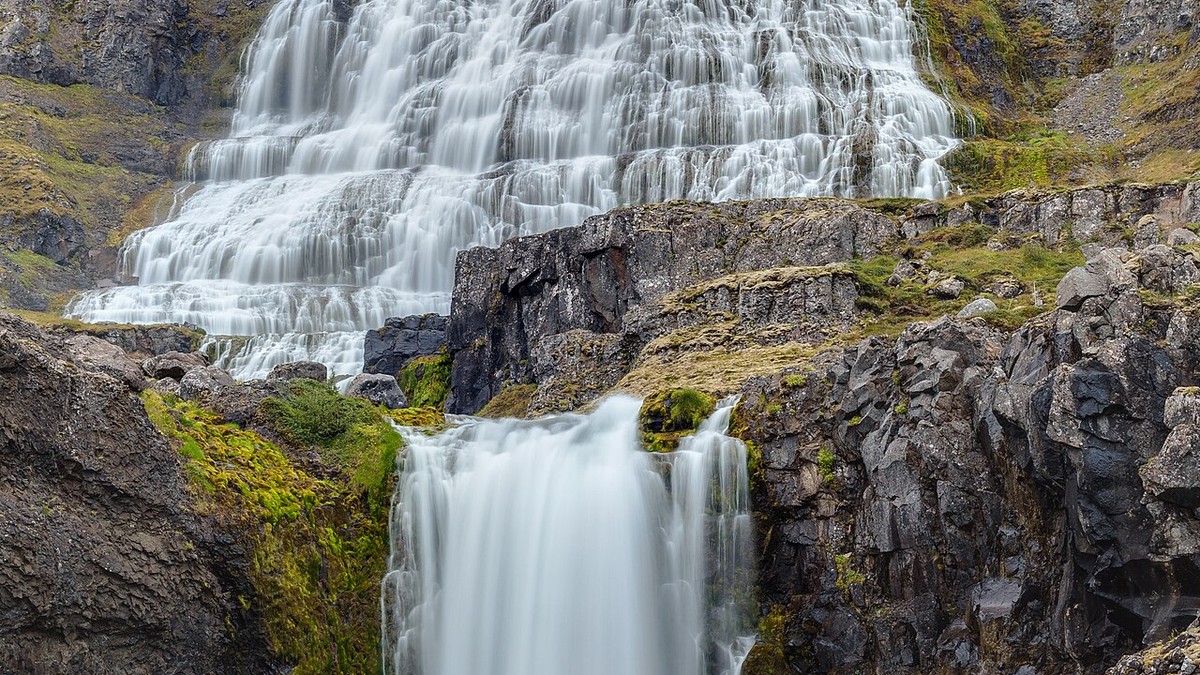
1. Taxonomy of Vertical Fluvial Descents: Fluid Dynamics and Boundary Conditions
Waterfalls exhibit an extraordinary spectrum of physical forms, ranging from towering, free-leaping vertical jets that atomize into aerosol clouds before reaching the ground, to broad, multi-channeled cascades that tumble across complex stepped rock faces. To systematically evaluate and classify this morphological diversity, geomorphologists, hydrologists, and fluid dynamicists rely upon taxonomic frameworks that integrate fluid boundary mechanics, channel cross-sectional geometry, slope angle, and the degree of jet contact with the underlying bedrock wall.
The foundational parameter governing waterfall taxonomy is the flow detachment condition. When a flowing fluid encounters a sharp discontinuity in bed slope, the momentum of the water column carries it beyond the bedrock lip. If the inertial force of the fluid exceeds the downward gravitational deflection within the initial boundary layer, the fluid stream detaches completely from the rock face, transforming into a free-falling hydraulic trajectory known as a nappe. Conversely, if bed slope transitions more gradually or bedrock roughness maintains continuous boundary layer attachment, the flow remains in contact with the rock surface, dissipating kinetic energy via turbulent friction rather than gravitational free fall.
The trajectory of a detached water nappe is mathematically modeled through parabolic ballistics modified by air entrainment. For an unventilated nappe—where air cannot freely circulate beneath the falling water sheet—a sub-atmospheric low-pressure zone (partial vacuum) develops between the rock face and the water curtain. This aerodynamic suction deflects the falling jet backward toward the cliff face, inducing intense cyclic jet flutter, structural vibration, and enhanced spray-zone erosion. In contrast, a well-ventilated nappe allows atmospheric pressure to equalize behind the curtain, permitting the jet to pursue a natural gravitational parabola.
Beyond fluid detachment, waterfall morphology is governed by the ratio of river discharge to vertical drop height, the structural dip and fracture density of the bedrock, and the frequency of multi-stage steps. Modern limnological and geomorphic classifications divide vertical fluvial descents into eight primary morphological categories: Plunge, Cataract, Tiered (Stepped), Horsetail, Segmented, Block (Sheet), Punchbowl, and Cascade systems.
💧 Hydraulic Principle: The Detached Nappe Condition
A true plunge waterfall occurs only when the Froude number (Fr = v / sqrt(g·y)) of the approach channel and the sharpness of the knickpoint lip satisfy the conditions for complete boundary detachment. If the nappe remains unventilated, aerodynamic vacuum pressure sucks the water sheet against the rock, generating severe cavitation and acoustic resonance.
2. Plunge and Punchbowl Systems: Free Fall and Rotational Churning
The Plunge Waterfall is the classic archetype of vertical knickpoints. In a pure plunge waterfall, the river drops vertically through the air without maintaining any physical contact with the underlying bedrock scarp. This morphology arises where a competent, horizontal caprock terminates abruptly over an undercut cliff face, allowing the nappe to clear the base rock completely.
Because the descending water encounters zero bed resistance during its free fall, gravitational acceleration maximizes impact kinetic energy at the base. Plunge waterfalls consistently excavate deep, classic plunge pools characterized by concentric hydrodynamic recirculation. Prominent global exemplars include Angel Falls (Salto Ángel) in Venezuela, which drops 807 meters in a single unbroken plunge from the summit of the Auyán-tepui, and Snoqualmie Falls in Washington State, USA.
A specialized, hydrodynamically intricate variation of the plunge form is the Punchbowl Waterfall. In a punchbowl system, a high-velocity river is laterally constricted into an exceptionally narrow, constricted bedrock notch or flume before descending. As the pressurized water jet blasts through this narrow aperture, it bursts into a wider, amphitheater-like plunge basin, dropping into a deep, circular catchpool that resembles a punchbowl.
The fluid dynamics of punchbowl waterfalls are defined by intense rotational vorticity. Because the incoming jet strikes the circular pool off-center or within a confined geometry, it initiates a high-velocity horizontal whirlpool (swirl chamber). This rotational vortex drives clastic boulders around the perimeter of the pool in continuous circular trajectories, functioning as a giant planetary drill that polishes the amphitheater walls and scours the basin floor to immense depths. Wailua Falls in Hawaii and Punch Bowl Falls on Eagle Creek in Oregon exemplify this dynamic.
| Morphological Type | Bedrock Contact | Flow Width vs. Height | Hydrodynamic Trajectory | Prominent Exemplars |
|---|---|---|---|---|
| Plunge | Zero contact (Free falling nappe) | Height >> Width | Vertical ballistic parabola; deep plunge pool | Angel Falls (VEN), Snoqualmie Falls (USA) |
| Cataract | Continuous to semi-detached | Discharge & Volume >> Height | Enormous volume, extreme turbulent stream power | Inga Falls (DRC), Boyoma Falls (DRC), Victoria (ZAM) |
| Tiered / Stepped | Multi-stage sequential contact | Stepped vertical drops | Successive knickpoint steps with intermediate basins | Gullfoss (ISL), Plitvice Lakes (CRO), Yosemite (USA) |
| Horsetail | Continuous contact with rock face | Height > Width | Maintains surface contact; fans outward along incline | Bridalveil Fall (Yosemite), Reichenbach Falls (SUI) |
| Block / Sheet | Detached to semi-detached | Width >= Height | Wide rectangular horizontal crest; uniform sheet | Niagara Falls (USA/CAN), Rhine Falls (SUI) |
| Segmented | Separated into distinct channels | Width > Height | Divided by rock islands or protruding buttresses | Iguazu Falls (ARG/BRA), Seven Wells (MYS) |
3. Cataracts and Block Falls: Massive Volume and Sheet Hydrodynamics
While plunge falls are defined by vertical drop height, Cataracts are defined by staggering volumetric discharge and raw hydrodynamic fury. In hydrologic terminology, a cataract is an immense, powerful waterfall or series of rapids that conveys colossal volumes of water over a substantial gradient. Cataracts represent the highest instantaneous stream-power environments in the fluvial world.
The premier global example of a cataract system is Inga Falls on the lower Congo River in the Democratic Republic of the Congo. While Inga Falls drops only 96 meters over a run of 15 kilometers, it discharges an astonishing mean annual volume of approximately 42,000 cubic meters per second (m³/s), peaking above 70,000 m³/s during equatorial flood surges. The sheer kinetic energy generated at Inga Falls dwarfs all other waterfalls on Earth, producing massive standing waves, standing hydraulic jumps exceeding 10 meters in height, and violent sub-surface whirlpools (suck-holes) capable of pulling entire tree trunks hundreds of meters underwater.
In contrast to turbulent rapids-dominated cataracts, Block Waterfalls (or Sheet Waterfalls) descend from a wide, structurally uniform horizontal riverbed over a distinct vertical precipice, maintaining a broad, rectangular sheet-like geometry. The width of a block waterfall is typically equal to or significantly greater than its vertical fall height. The approach flow is characterized by uniform subcritical open-channel flow that transitions smoothly to critical flow precisely at the knickpoint crest (the brinkline).
Niagara Falls (specifically the Horseshoe Falls, with a crest width of 790 meters and a height of 57 meters) and the Rhine Falls in Switzerland (width of 150 meters, height of 23 meters) represent quintessential block waterfalls. The uniform transverse distribution of water across a block fall distributes erosional forces across a wide front, promoting parallel crest retreat and suppressing localized incision.
The Hydraulic Jump at Cataract Terminations
At the base of massive cataracts and block falls, the high-velocity shooting flow (supercritical regime, Fr > 1) must transition into deep, tranquil downstream river flow (subcritical regime, Fr < 1). This mandatory hydrodynamic transition occurs via a hydraulic jump—an extremely turbulent standing shockwave where kinetic energy is violently converted into potential energy, entraining massive volumes of air, creating boiling rollers, and dissipating millions of horsepower of mechanical energy.
4. Tiered, Stepped, and Travertine-Dammed Cascades
Where geological strata consist of alternating layers of varying resistance, or where structural faulting creates stepped topography, waterfalls evolve into Tiered (or Stepped) systems. A tiered waterfall comprises a sequential series of distinct vertical drops, each featuring its own plunge pool or intermediate bench, linked together in a continuous fluvial staircase.
Yosemite Falls in California is a world-renowned tiered system: Upper Yosemite Fall plunges 436 meters in a single free fall, followed by a middle series of four steep cascades descending 206 meters through a narrow granite notch, terminating in Lower Yosemite Fall, which drops 97 meters into an accessible boulder basin. Tiered systems exhibit complex energy dissipation profiles; intermediate pools absorb kinetic energy, decelerating flow before it accelerates over subsequent lower steps.
A visually dazzling and limnologically unique subclass of stepped cascades are Travertine-Dammed Waterfalls, celebrated at sites such as Plitvice Lakes National Park in Croatia, Jiuzhaigou Valley in China, and Band-e Amir in Afghanistan. These stepped cascades are not carved by mechanical bedrock erosion; rather, they are continuously constructed by active biochemical mineral precipitation.
In karst terrains rich in dissolved calcium bicarbonate (Ca(HCO3)2), turbulent degassing of carbon dioxide (CO2) over small rapids shifts chemical equilibrium, driving the precipitation of solid calcium carbonate (CaCO3) as porous tufa or travertine: Ca²⁺ + 2 HCO3⁻ → CaCO3(s) + CO2(g) + H2O. This mineral precipitation is intensely accelerated by photosynthetic cyanobacteria, bryophytes (mosses), and micro-algae that encrust river obstacles. Over centuries, these biogenic travertine barriers grow upward and outward into massive natural dams, impounding chains of crystal-clear turquoise lakes separated by cascading travertine waterfalls that continuously heal erosional breaches through ongoing mineralization.
💧 Biogeochemical Phenomenon: Autocatalytic Travertine Dams
Travertine barriers grow fastest at the point of maximum water turbulence, where physical agitation drives rapid CO2 degassing. Consequently, if a breach occurs in a travertine waterfall dam, the accelerated flow through the breach paradoxically accelerates calcium carbonate precipitation, self-healing the dam over decades.
5. Horsetail, Fan, and Segmented Waterfalls
When descending water maintains continuous physical contact with the underlying bedrock wall along a very steep or near-vertical slope, the feature is classified as a Horsetail Waterfall. In a horsetail fall, the water column does not detach into an airborne nappe; instead, it hugs the rock face, spreading outward and fanning across irregularities in the bedrock surface to resemble the flowing tail of a horse.
A classic variation is the Fan Waterfall, where a narrow approach stream drops onto a broad, sloping bedrock face, spreading outward laterally into a wide, decorative triangle of white water. Bridalveil Fall in Yosemite National Park and Multnomah Falls’ upper reaches showcase spectacular horsetail dynamics during low to moderate discharge stages. The fluid dynamics of horsetail falls are dominated by high boundary layer skin friction, which aerates the thin water sheet into brilliant white foam (macroturbulence) and dissipates kinetic energy along the entire rock face, preventing the excavation of deep plunge pools at the base.
Conversely, Segmented Waterfalls occur where the river is physically divided into two or more distinct, parallel streams of falling water as it descends. This segmentation is driven by durable bedrock buttresses, mid-channel islands, or resistant vertical volcanic dykes that bisect the channel crest. Iguazu Falls on the Argentina-Brazil border represents the planetary pinnacle of segmented waterfall systems: across a semicircular basalt amphitheater stretching 2.7 kilometers in width, the Iguazu River splits into between 150 and 300 individual cataract segments (depending on seasonal discharge), separated by forested basalt islands and rocky promontories.
6. Quantitative Rating Scales: The Beisel Waterfall Index
Comparing and ranking waterfalls across the globe has historically been complicated by the trade-off between drop height and volumetric discharge: Is Angel Falls (height: 979 m, low flow) ‘greater’ than Inga Falls (height: 96 m, colossal flow) or Niagara Falls (height: 57 m, massive flow)? To resolve this dilemma, hydrologists and quantitative geographers formulated standardized logarithmic rating systems, most notably the International Waterfall Classification System and the Beisel Waterfall Index.
Developed by Richard Beisel in the late 20th century, the Beisel scale assigns waterfalls a standardized numerical rating based on a logarithmic calculation incorporating both vertical fall height (H, in meters) and mean annual volumetric discharge (Q, in cubic meters per second): Class = log10(H · Q^k) or similar multi-variable scoring models. In the ten-class global system:
- Class 10 Waterfalls: Planetary monsters exhibiting astronomical discharge and substantial height, including Inga Falls, Boyoma Falls, Niagara Falls, Victoria Falls, and Iguazu Falls.
- Class 7 to 9 Waterfalls: Major regional cataracts possessing either exceptional height with moderate volume (Yosemite Falls, Kaieteur Falls) or high volume with modest drop (Rhine Falls, Dettifoss).
- Class 1 to 4 Waterfalls: Small mountain cascades, seasonal alpine trickles, and low-gradient woodland chutes.
These quantitative classification systems provide an objective framework for comparing fluvial energy dissipation across diverse climatic and tectonic regimes. By integrating fluid mechanics, structural geology, and quantitative rating metrics, scientists can systematically analyze how these monumental knickpoints shape continental drainage architecture and influence global freshwater ecology.